How Tanning Accelerators Work: The Science of Melanin and Skin

Your skin already knows how to tan. It just does it slowly.
That single fact explains why so many people misunderstand how tanning accelerators work. These products don't paint colour onto you. They support a process that your body runs naturally.
In this guide, you'll learn the actual biology. We'll cover what melanin is, how UV light triggers it, and why certain skincare ingredients protect your skin while colour develops. By the end, you'll evaluate any tanning product like a specialist.
What melanin actually is
Melanin is a natural pigment your body produces. It lives in specialised cells called melanocytes, deep in your skin.
Its main job is protection. When UV light hits your skin, melanin absorbs and scatters some of that radiation. That shielding response is what we see as a tan.
So a tan is not just cosmetic. It's your skin's defence mechanism working in real time.
Two types of melanin
Not all melanin behaves the same way. Two forms shape how your tan looks.
- Eumelanin produces brown and black tones. It drives that deep, rich colour.
- Pheomelanin produces red and yellow tones. It offers weaker UV protection.
Your genetic ratio of these types explains why some people tan easily. Others burn first and struggle to build depth.
How UV light triggers a tan
Tanning starts with a signal. UV exposure damages skin cells slightly, and your body responds.
That response tells melanocytes to ramp up production. They create more melanin and push it toward the surface. The pigment then distributes across nearby skin cells.
This is UV tanning at its core. It's a controlled biological reaction, not an instant one.
Why does it feel slow?
Melanin production takes time to activate and travel. That delay is why a single session rarely delivers dramatic colour.
For many people, the process feels frustratingly inefficient. You put in the UV time but see little payoff early on.
That gap is exactly where accelerators earn their place.
How tanning accelerators work
A tanning accelerator supports and speeds up your natural melanin response. It does not replace UV exposure; it works alongside it.
The core idea is simple. Melanin activators help your melanocytes respond faster and produce pigment more efficiently. You get a deeper colour from the same UV time.
That's the honest science. No stain, no dye, no shortcut around your own biology.
What melanin activators do
Melanin activators are ingredients that stimulate or support pigment production. Some encourage melanocyte activity directly. Others create better conditions for melanin to develop and settle evenly.
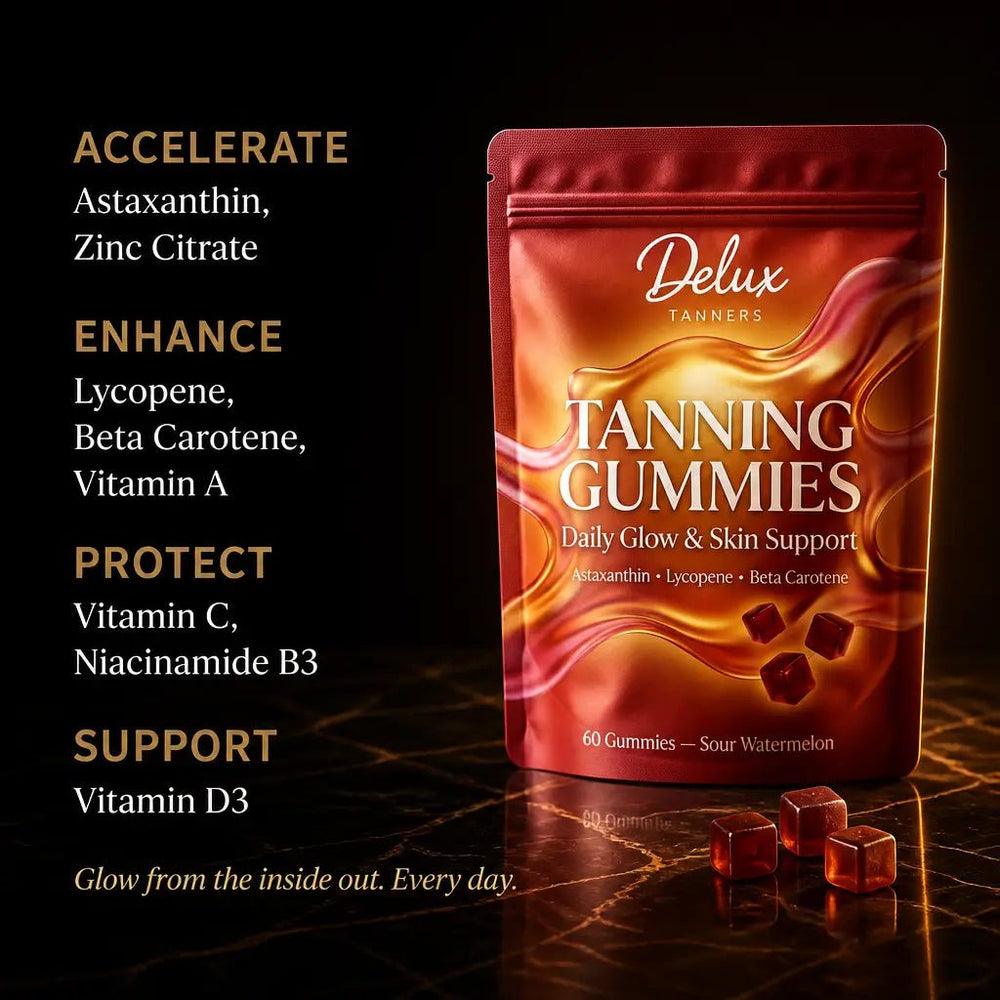
Delux Tanners builds its formulas around next-generation melanin activators. Several actives work together to drive a faster, deeper, more even result.
The outcome is real colour from your skin with no DHA and no bronzer involved.
Buy Now
Why skincare ingredients matter during tanning
Here's the part most tanners overlook. UV exposure stresses your skin barrier, even when it's working correctly.
That stress can cause dryness, tightness, and flaking. Dry skin also holds a tan poorly, so your colour fades unevenly.
Good sunbed skincare solves both problems at once. It supports the barrier while pigment develops, protecting your investment in every session.
The three ingredients worth knowing
Delux includes medical-grade skincare actives that most tanning products skip. Each one plays a specific role in skin barrier tanning.
- Ceramides reinforce the skin barrier and reduce moisture loss. A stronger barrier means healthier, longer-lasting colour.
- Squalane delivers lightweight hydration without a greasy film. Well-hydrated skin looks smoother and reflects a more even tan.
- Ectoin is a cell-protective molecule studied for shielding skin from environmental stress. It helps skin cope during UV exposure.
Together, these ingredients keep skin conditioned while your tan builds. That's the difference between colour that lasts and colour that flakes away.
Accelerators vs fake tan: the science difference
The distinction comes down to chemistry. It's worth understanding before you buy anything.
Fake tans use DHA, a chemical that reacts with dead surface skin cells. That reaction creates a temporary brown stain that sits on top.
Accelerators work differently. They stimulate your own melanin, so the colour originates inside living skin. That's why the result looks natural and never turns orange.
Pros and cons of tanning accelerators
A balanced view helps you decide with confidence.
Pros
- Boost your natural tan faster from the same UV time
- Produce genuine, natural-looking colour with no orange tint
- Work indoors on sunbeds and outdoors in the sun
- Quality formulas hydrate and protect the skin barrier
- No streaking, since colour comes from within
Cons
- They require UV exposure to work
- Colour builds gradually over several sessions
- Well-formulated options cost more than basic lotions
How to choose a tanning accelerator wisely
Use the science to guide your decision. These criteria separate strong products from weak ones.
- Check the mechanism. Look for melanin activators, not DHA or bronzer.
- Read the skincare list. Ceramides, squalane, and ectoin signal a barrier-first formula.
- Confirm dual use. A good accelerator works for both sunbed and outdoor tanning.
- Review the proof. Verified reviews reveal real-world consistency.
Delux Tanners meets all four criteria, which is why it works well as a benchmark example.
If you'd like a formula matched to your skin and routine, the brand's quick quiz makes it simple.
Frequently asked questions
How do tanning accelerators work?
They stimulate your skin's natural melanin production during UV exposure, so you build deeper colour faster from the same session time.
Are tanning accelerators the same as fake tan?
No. Accelerators boost your own melanin, while fake tan uses DHA to stain the skin's surface.
Do melanin activators permanently change your skin?
No. They temporarily support your natural tanning response. Colour fades as skin cells renew.
Why do ceramides and ectoin matter for tanning?
They protect and hydrate the skin barrier during UV exposure, helping colour develop evenly and last longer.
Can accelerators work without sunbeds or the sun?
No. They need UV exposure to trigger melanin, so they won't tan you indoors alone.
How long before accelerators show results?
Most people notice deeper colour within a few consistent sessions, as melanin production ramps up.
The bottom line
Tanning is biology, not magic. Your skin produces melanin to protect itself, and accelerators simply help that process run faster and more evenly.
The smartest products pair melanin activators with barrier-supporting skincare. That combination protects your skin while it builds genuine, lasting colour. Delux Tanners follows this exact model with its next-gen, skincare-first approach.
Your next step is easy. Learn to read a label using the science above, then match a formula to your skin type before your next session.